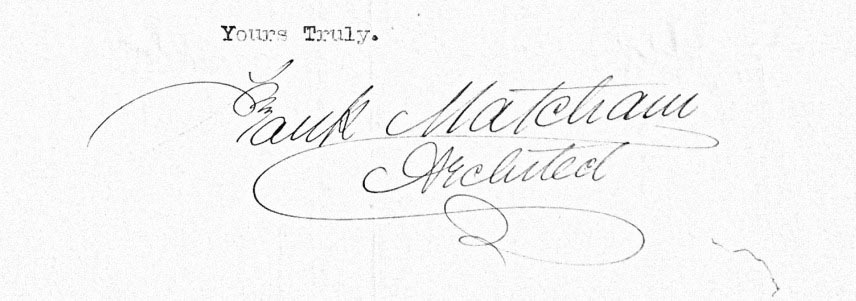
Vanity Fair Caricature Print - Frank Matcham Architect
Back to: Vanity Fair Prints Home

Title: Architect Matcham
Date: 5th July 1911
Description: Photolithograph print by Nibs. Extremely scarce. Depicts Frank Matcham the reknowned theatre architect. Not published in the half yearly or annual volume, only in the magazine.
Condition: Good image some minor marginal blemishes. Very scarce.
Image size: 375mm × 250mm
14.5 x 10" approx.
£475.00
Order No. 11689a
Click here for framing suggestions
Guaranteed original antique prints, we do not sell modern reproductions.
Original Vanity Fair print for sale
Francis Matcham (22 November 1854 – 17 May 1920) an architect who specialised in the design of theatres and music halls. Born in Devon the son of a brewery clerk. He was brought up in Torquay where he went to Babbacombe school. In 1868 he became apprenticed to George Bridgman a local builder and architect. In the mid 1870’s he moved to London to join the architectural practice of Jethro Robinson who was consulting theatre architect to the Lord Chamberlain. In 1877 Matcham married Robinson’s daughter and the following year when Robinson died suddenly, the 24 year old Matcham found himself taking over the practice.
His first major job was to complete the Elephant and Castle Theatre which Robinson had started. Following this, Matcham went from success to success and over the next 30 years he became unrivalled as the most prolific theatre architect of all time.
He worked most commonly in London, mainly for Moss Empires, a theatre building business headed by Edward Moss and run by Oswald Stoll. Matcham completed twenty one theatres for Moss, including the Hippodrome in 1900, Hackney Empire (1901), Coliseum (1903) and Palladium (1910). His last major commission before retirement was the Victoria Palace (1911) for the variety magnate Alfred Butt. Also during this professionally prolific time and away from Moss Empires, he completed the designs for the Tower Ballroom at Blackpool Tower, Grand Theatre, Blackpool and the Theatre Royal, Norwich, all in 1894, and the County Arcade, Leeds, in 1900.Matcham's use of cantilevers for the galleries allowed him to avoid the use of columns, which would normally obstruct the audience's view of the stage. The auditorium decorations were often mixed with Tudor strap-work, Louis XIV detail, Anglo-Indian motifs, naval and military insignia, rococo panels, classical statuary, and baroque columns.
During his 40-year career, Matcham was responsible for the design and construction of over 90 theatres and the redesign and refurbishment of a further 80 throughout the United Kingdom. Matcham retired to Westcliff-on-Sea, Essex, shortly before the First World War, where he died of a heart attack, brought about by a blood infection, in 1920.
Mon - Closed
Tues-Fri 10am-1.30pm, 2.30-5.30pm
Sat 10am-1.30pm
© Alpha Websites
 Free UK Mainland Delivery*
9 Church Street
Modbury
Devon PL21 0QW. UK
01548 830872